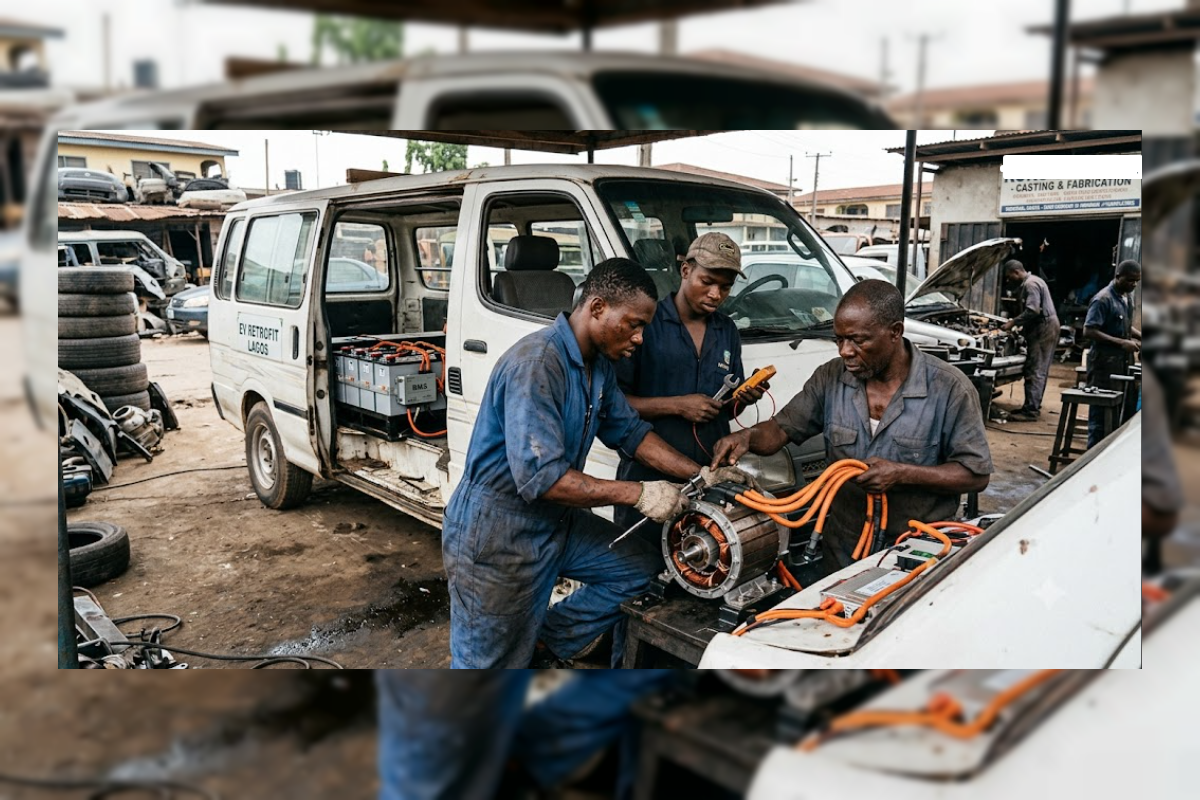

As fuel prices rise and the continent seeks to insulate its economies from volatile refined petroleum imports, the future of sustainable transport relies heavily on a unique approach: EV retrofitting.
Instead of waiting decades for expensive, brand-new electric cars to become affordable for the average consumer, local African technicians are taking the initiative. They are stripping out old, sputtering internal combustion engines (ICE) from existing vehicles and replacing them with clean, battery-powered electric drivetrains. This grassroots engineering shift is transforming how the continent moves, extending the lifespan of thousands of vehicles while driving localized industrial growth.
Why Retrofitting Fits the African Context
For many African nations, importing brand-new passenger EVs is currently impractical due to steep foreign exchange costs, high shipping fees, and limited public charging infrastructure. However, the commercial sector tells a completely different story.
Minibuses, delivery vans, commercial motorcycles, and urban tricycles form the backbone of local logistics and mass transit. These vehicles run on highly predictable, repetitive routes, making them ideal candidates for electrification. A logistics van or a commuter minibus that drives a fixed route can return to a centralized depot or workshop to charge overnight or utilize local battery-swapping networks.
Retrofitting bridges the economic gap. By stripping out the hardware of a conventional gasoline or diesel engine—including the motor, gearbox, fuel system, and exhaust—and substituting them with a traction motor, a battery pack, and a battery management system (BMS), technicians give an older vehicle a second life at a fraction of the cost of buying a new EV.
The Unsung Heroes: Local Technicians and Foundries
The true architects of this transition are the local technicians, engineers, and informal metal artisans who possess an intimate understanding of vehicle durability under local road conditions. Transforming a fuel-dependent vehicle into a functional electric machine requires massive resourcefulness and hyper-local collaboration.
When an electric motor is retrofitted into an older vehicle chassis, it rarely fits the original structural design. This is where the synergy between local mechanics and domestic foundries becomes critical:
- Custom Adapters: Technicians collaborate with local foundries to cast bespoke aluminum or iron adapter plates that couple the new electric motor directly to the vehicle's existing transmission.
- Structural Engineering: Metal fabricators weld custom structural brackets and robust steel battery enclosures designed to shield sensitive lithium-ion cells from rough terrains and road debris.
This interconnected local supply chain ensures that value stays within the community. Instead of relying purely on imported, one-size-fits-all conversion kits, African workshops are beginning to manufacture localized mounting kits, specialized wiring harnesses, and reinforced structural components tailored to the specific vehicle models dominating African roads.
Overcoming Grid Constraints with Local Ingenuity
A common critique of EV adoption in Africa is the unreliability of national power grids. To bypass this barrier, technicians and e-mobility startups are embedding localized energy solutions directly into their operational models.
Workshops are increasingly integrating off-grid, solar-assisted charging hubs into their ecosystems. Because commercial vehicles operate primarily during daylight hours, daytime solar generation can charge standby batteries. These batteries can then fast-charge commercial delivery fleets or power high-efficiency battery-swapping stations for two- and three-wheelers, completely avoiding grid congestion.
The Digital Layer: Fleet Management and Data
The modern African retrofitting ecosystem is fundamentally data-driven. Once a vehicle is converted to electric power, it transitions into a highly connected digital asset. Local tech builders and startups are developing custom, lightweight garage management software and mobile platforms designed to monitor these retrofitted vehicles in real time.
By integrating smart mobility platforms, fleet managers and drivers can track automated payments, map out active battery-swapping kiosks, monitor real-time energy consumption, and check the health of individual battery packs.
This data collection is highly beneficial for after-sales support. It removes the guesswork from maintenance, allowing local technicians to diagnose minor electrical or cell-balancing issues before they escalate into major hardware failures.
Charting the Path Forward
For EV retrofitting to transition from a scattering of innovative pilot projects to a mainstream industrial sector, targeted capacity building and clear technical standards are essential. Educational institutions and local tech hubs are stepping up to create specialized training programs, teaching traditional auto-mechanics how to safely handle high-voltage electrical systems, program motor controllers, and service advanced battery arrays.
As regulatory frameworks evolve and governments explore incentives like targeted tax exemptions on imported battery cells, the groundwork is being laid for an independent, circular automotive economy. The future of African e-mobility will not be imported; it will be built, adapted, and sustained right here by the ingenuity of local technicians.

Comments (0)
No comments yet. Be the first!
Please login to leave a comment
Login to Comment